
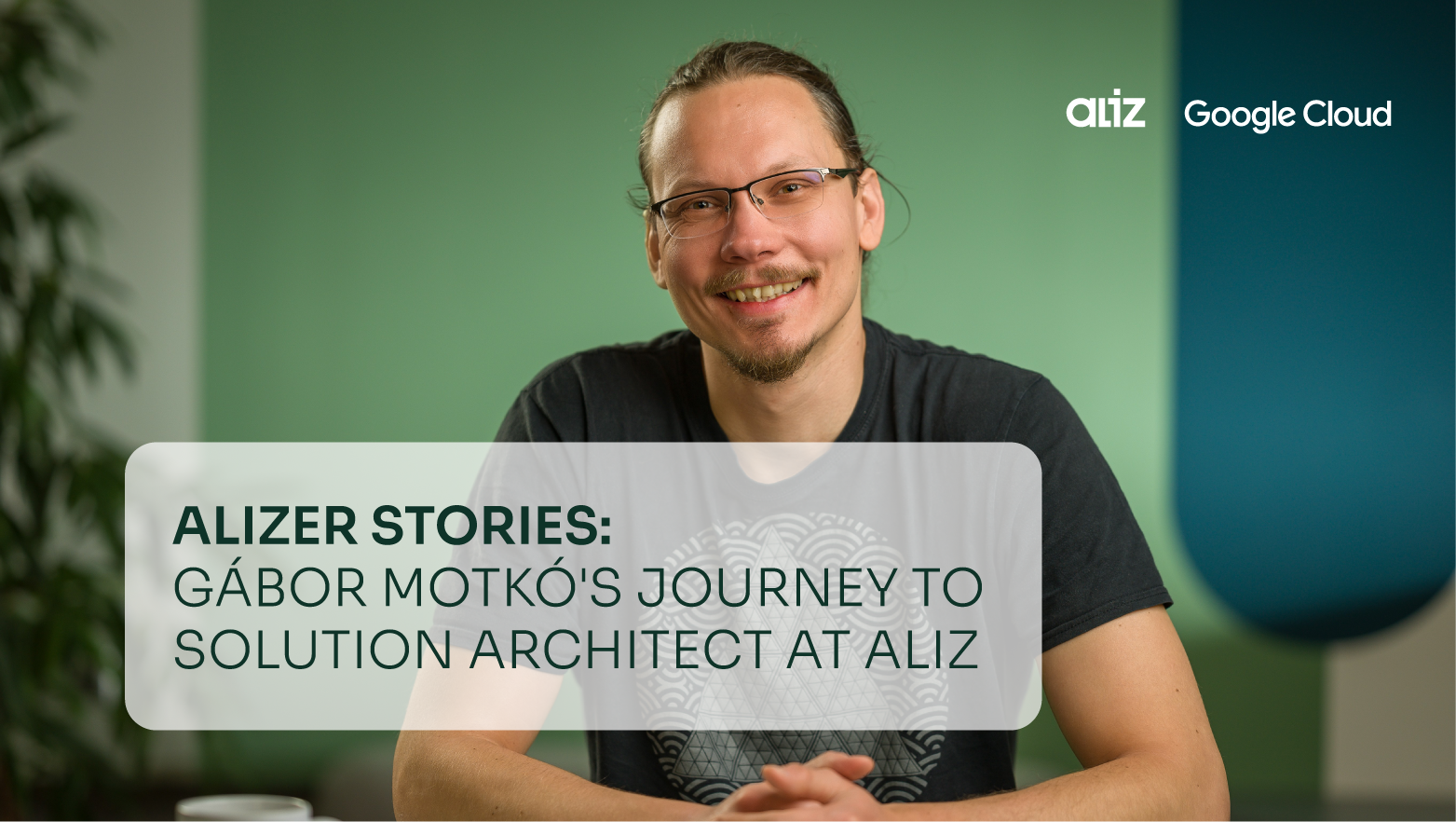
Great cloud solutions don't emerge from thin air, they're engineered, piece by piece, by people who know both the code and the bigger picture. Today, we're sitting down with Gábor Motkó, Solution Architect at Aliz, to talk about his professional evolution that brought him to where he is today.
Solution Architect is one of those job titles that sounds self-explanatory until you actually see what the role involves. At Aliz, being a Solution Architect is a highly dynamic, customer-centric specialization, where deep technical execution meets high-level business strategy.
“As a Solution Architect, you're part of that bridge between the technical engineering teams and the customer's business stakeholders. You will be involved from the very start, when you and the sales team are the ones making the first impression," Gábor explains.
Solution Architects wear many hats, sitting at the intersection of technology, customer engagement, commercial awareness, and domain fluency across industries. The role demands strong communication and the ability to quickly translate a client's pain points into a concrete technical direction.
Day to day, that means pre-sales work, positioning Aliz to prospective clients, estimating project timelines, building proof of concepts, and mentoring teammates. In a single week, a Solution Architect might move from a deep data architecture discussion to working alongside sales on a proposal, learning a client's business model from the ground up, and presenting to a boardroom, all while building the technical credibility that keeps clients coming back.
What drew Gábor to the role was pre-sales, although many engineers approach it with dread. Requirements are vague, timelines tight, and there's no guarantee the effort converts into anything. Gábor sees that open-endedness as an advantage. When a client request is unclear or even unreasonable, a well-crafted proposal can do more than respond to it, it can reframe it. "Even by giving a proposal, you can guide them into a better direction," he says. "The client may realize from the offer that you understand their actual needs, and that you're able to formulate their problem more accurately than they can themselves."
For Gábor, pre-sales is genuine creative work. "It's not just about sweating and estimating and dealing with the unknown," he explains. "You can bring a lot of creative ideas into it." The ambiguity is where the opportunity lives. It’s a chance to shape the conversation, guide a client toward a better solution than they originally envisioned, and demonstrate expertise in a way a polished slide deck never quite can. "Clients are reasonable people too, who can and should be convinced about a mutually beneficial solution, even if it's not quite the same as they initially envisioned."
It isn't easy. Pre-sales demands comfort with ambiguity that not every technically-minded person has, plus the conviction to stand in front of a room, sometimes against stiff competition, and make the case that your team understands the problem better than anyone else in the running. But there's a particular energy in doing that alongside a team aligned on the same goal. At Aliz, the Solution Architect doesn't operate alone; Customer Success Managers, Project Managers, and Sales colleagues are all pulling in the same direction.
"And what's the best thing? When we win together." For example, in one competitive pursuit, Aliz was one of more than ten companies that responded to an RFP, with at least four brought in to present in person. After a five and a half hour long presentation and discussion, Aliz won. "You start with thirty pages of vague requirements, a massive scope and at the end, you're the chosen ones. That feeling is hard to beat."
The Solution Architect role itself at Aliz is relatively new, and Gábor's path into it reflects a philosophy he's carried throughout his career: find the gap nobody is owning, and step into it. Pre-sales is one of those functions that most organizations, even large and well-resourced ones, tend to handle inconsistently. Gábor has been doing pre-sales work on and off since 2016, and when he saw the same pattern at Aliz, he raised his hand. Not because it was a natural career ladder step, but because he saw a gap and knew he could fill it meaningfully. "I wanted to be the foster parent of an orphaned process," is how he puts it.
As we touched on earlier, the Solution Architect role at Aliz is still relatively new, and so is the story of how Gábor grew into it. His path here didn't follow a straight line either.
He started where many engineers do: as a Java backend developer, building enterprise applications at companies including Evosoft, Senacor, and Accenture. Solid, technical, and deep, but contained within the boundaries of application development.
Then the shift into data, which wasn't planned. A large application development project came to an abrupt end, and Gábor was faced with a choice: move into data, or move into infrastructure. He chose data. In fact, his very first project at Aliz, which was a data project, had already given him a taste of it. Working closely with a colleague, he tackled a real challenge for a telco client, building a near-real-time database to handle massive subscriber transaction data. It clicked. “It was fun. I learned a lot, and I ended up in data.”
What followed was a period of deepening expertise. Leading data projects, working embedded with client teams, and owning delivery end to end. Eventually, that experience led him into the data architect role. But at Aliz, the data architect role was never purely about delivery; it also meant facing clients, scoping projects, and contributing to pre-sales. That dual exposure naturally shaped Gábor's path towards the Solution Architect role.
That expertise didn't develop in one place. Another defining thread in Gábor's career at Aliz is its international scope. His client work spans regions, from Southeast Asia to Central and Eastern Europe, reflecting both Aliz's global reach and his ability to navigate different business cultures and domains. But of all the markets he's worked in, DACH is where he's been most involved, since he speaks fluent German.
The story of how that happened isn't what you'd expect. Growing up in Hungary in the early 1990s, German TV channels were the only ones showing cartoons every day, so at two or three years old, he simply started watching without understanding a word. "I learned it the same way I learned Hungarian," he says. "Just by listening."
Gábor began working with German-speaking clients in 2011, spent two years living and working in Germany between 2013 and 2015, and at his previous company was regularly assigned to German client projects because of his language skills. By the time he joined Aliz, working with German clients wasn't new territory. For a Hungarian professional, German fluency isn't just a nice-to-have, it's a natural extension of the market. "It's very much of an advantage,” he says.
That advantage has found a natural home at Aliz, where DACH is a core strategic focus. Aliz has been active in the region for over six years, with a local sales team on the ground and German-speaking engineers in Hungary. In 2023, that commitment was recognized when Aliz was named Google Cloud Services Partner of the Year for the Alps region, which was the product of 15 years of exclusive focus on Google Cloud, producing a level of technical depth most competitors simply can't match.
For Gábor, that meant being at the center of some of Aliz's most significant client relationships in the region. His most formative project to date was leading a full BI migration for a Swiss department store chain, moving their entire data warehouse from Oracle and SAP to GCP, working embedded with the client's own engineers as one unified team. "That project is where I became a real data architect," he says. He's still working with them today, visiting in person once or twice a year — the kind of long-term partnership built on trust as much as technical delivery.
"I think we're good at selecting people with the right mindset," he says. "Smart, but also very considerate." What stands out to him is a culture that runs on argument rather than authority, where anyone can make a case to leadership, and where good reasoning actually lands. "You can go to anyone, even at the C-level, and convince them if your arguments are right. The people in leading positions are reasonable."
Then there's the people he gets to learn from. The team includes some of the most technically sharp professionals in the Google Cloud ecosystem. As a Solution Architect, he's closer to that knowledge than he’d be almost anywhere else outside of Google itself.
The flexibility matters too. The freedom to structure his own time, work from wherever makes sense, and take ownership of how he does his best work. As for the clients, after years at other companies navigating the demands of very large corporations, Gábor finds that Aliz's clients tend to be more practical and open to dialogue. The clients who find their way to Aliz tend to be the ones who actually want to move and change. 'Someone from our current client team once told me they chose us because they had the impression that we actually get things done, we're lean and pragmatic, which is exactly what they needed, since they struggle to get any changes done within their own company,' Gábor says.
Interested in building a career where your technical depth can evolve into something bigger? Aliz is always looking for people with the right mindset. Check out our open positions here and come join us! ☁️


.png)
.png)
.png)

.png)

