Tokenmaxxing and model leaderboards grab headlines, but enterprise reality has arrived: organizations are now strictly measuring AI’s value against its costs. As the AI era faces its newest “What’s the ROI?” moment, we joined the ride to analyze what actually moves the needle. Based on recent enterprise AI research and industry reports, here is a summary of the top 10 enablers for scaling AI across five core operational pillars: data foundations, infrastructure, governance, talent, and organizational alignment.[manyforce][agility-at-scale][dancumberlandlabs]
#
Enabler
Why It Matters
1
Data Readiness & Quality
Structured, cleaned, governed, and accessible data is the top predictor of scaling success; only 15–25% of enterprises currently have adequate data foundations.
[1][2][3]
2
AI Governance by Design
Embedded governance (bias monitoring, explainability, audit logging, runtime controls) enables innovation while managing risk and is a prerequisite for production deployment.
[1][2][3]
3
Scalable Infrastructure & MLOps
Elastic compute, standardized model serving, AI engineering, and ModelOps practices ensure reliability, observability, and sub-second inference at peak load.
[1][2][3]
4
Talent Strategy & AI Fluency
Addressing the 50% AI skills gap through upskilling, hiring, and partnerships; embedding AI fluency into hiring, performance reviews, and operating rhythms.
[1][2][3]
5
Outcome-Driven Use Case Prioritization
Starting with business outcomes—not technology curiosity—ensures resources flow to high-impact opportunities tied to revenue, cost, or customer experience.
[1][2][3]
6
Standardized AI Stack Components
Reusable model gateways, retrieval patterns, evaluation pipelines, tool connectors, and workflow templates accelerate deployment and reduce fragmentation.
[1][2]
7
Executive Commitment & Budget Allocation
High performers allocate >20% of digital budgets to AI; executive sponsorship and clear decision rights correlate directly with scaling success.
[1][2]
8
Cross-Functional Ownership & Workflow Redesign
Business-owned data stewardship, AI councils, and redesigned workflows (not just pilot projects) prevent IT bottlenecks and drive adoption.
[1][2][3]
9
FinOps & Cost Transparency
Predictable cloud/licensing drivers, reclaimed legacy spend reinvested into AI architecture, and right-sized infrastructure optimize total cost of ownership.
[1][2]
10
Change Management & Culture
Workforce readiness, resistance mitigation, and a culture where business users request AI enhancements determine adoption velocity.
[1][2][3]
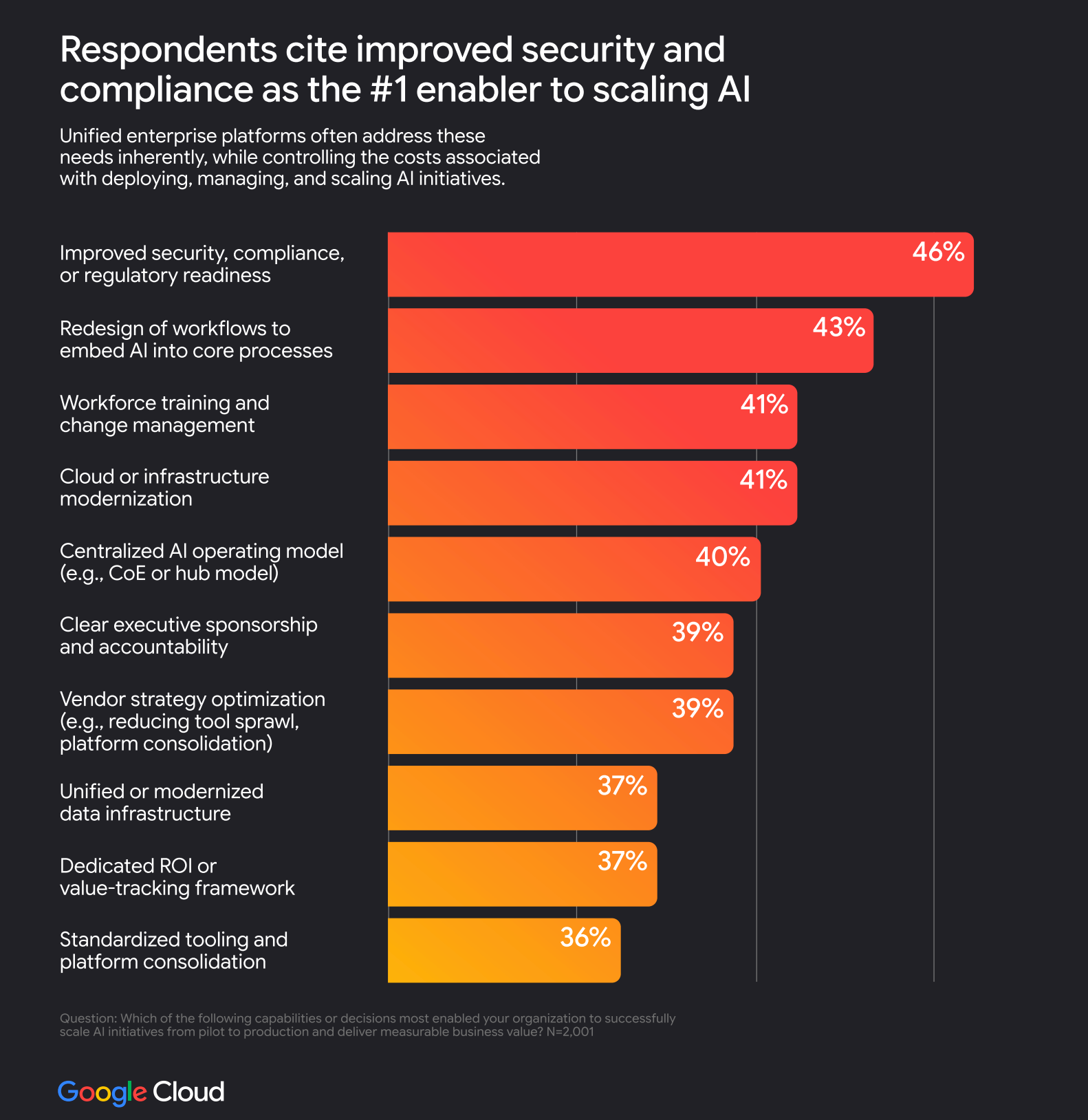
Google’s own research with with National Research Group to survey 2,403 executives across the globe paints a similar picture:
Key Takeaways
Most scaling failures originate in organizational and governance gaps, not model quality.[smartdev]
Enterprises that scale successfully treat AI as a transformation program, not a technology project—aligning people, orchestration, and governance from day one.[dataiku]
A phased roadmap with measurable gates (quick wins → pilots → production → enterprise-wide) builds credibility and learning while managing risk.[agility-at-scale][tezeract]
Bonus - Here’s five questions to ask if you want to scale AI:
Page 1 — Which workflow?
Start with one workflow that is expensive, slow, repetitive or strategically important and already has a named business owner. If the workflow is vague, the value case will be vague too.
Page 2 — Who owns production?
List the business owner, technical owner, data owner, security approver and legal / compliance stakeholder. Then name the one person accountable for moving the workflow through the full path. Shared involvement is not the same as ownership.
Page 3 — What must the agent connect to?
A useful enterprise agent needs access to real systems and data. Identify the required connectors early and validate access, permissions, data location and security requirements before the architecture becomes expensive to change.
Page 4 — What will prove value?
Choose a small number of measures: active use, workflow completion, time avoided, quality, response speed or another business baseline. Measure the before-state before the pilot begins.
Page 5 — What happens after the pilot?
A pilot is only useful if the production owner, support model, training plan and next workflow are already visible. The goal is not one isolated success; it is a repeatable approval and rollout path.

.png)



.png)
.png)
.png)

.png)

