

The conversation about AI has become exhausting. Another week, another groundbreaking model. Another promise of transformation. Another pilot project that somehow never makes it to production.
We've watched this cycle for eighteen months now, and something interesting has emerged from the noise: the technology works. The problem isn't the AI anymore. It's everything else.
Let's start with an uncomfortable truth. Most companies still don't know how to leverage their data properly. Early adopters like e-commerce, financial services, and trading have built empires on data capabilities. But for the majority? There's simply too much data to manage, understand, and monetize.
The traditional path is expensive and often leads nowhere. Build the foundation layer, establish a data lake, implement complex transformations—and you've burned hundreds of thousands of dollars to achieve basic analytical capabilities. Many CIOs find themselves trapped in this cycle, unable to justify the initial investment against clear ROI. Leaders are caught in an uncomfortable position: history shows that breakthrough tools require experimentation and failure, but corporate incentives punish both. And so we default to what worked before—even when we know it won't work again.
Here's what makes this moment different though: AI has changed what "full potential" means. It's no longer about dashboards and quarterly reports. The real value starts when AI becomes the primary consumer of your data warehouse—when operational workflows get enhanced, when your customers receive support that's faster, more consistent, and more accurate than human teams alone could provide.
Everyone wants to talk about AI. But the major part of the iceberg that sits beneath the surface is getting your data in shape on the cloud. AI is only as good as the data it is fed. This is why we're calling on every CIO and CITO to start their cloud data warehouse journey now, even if it means starting small. When your organization is ready for AI—and that moment is closer than you think—you'll need this foundation. There's no shortcut around it.
Yes, security conversations are extensive. But in our eight years migrating hundreds of customers to Google Cloud, including highly regulated financial institutions, we've always found compliant solutions. If security concerns are holding you back, let's have that conversation. There's a path forward.
Large language models introduced something we call cognitive translation: the ability to understand intent across different systems without requiring integration. They translate between systems while maintaining context.
This enables a fundamentally different workflow:
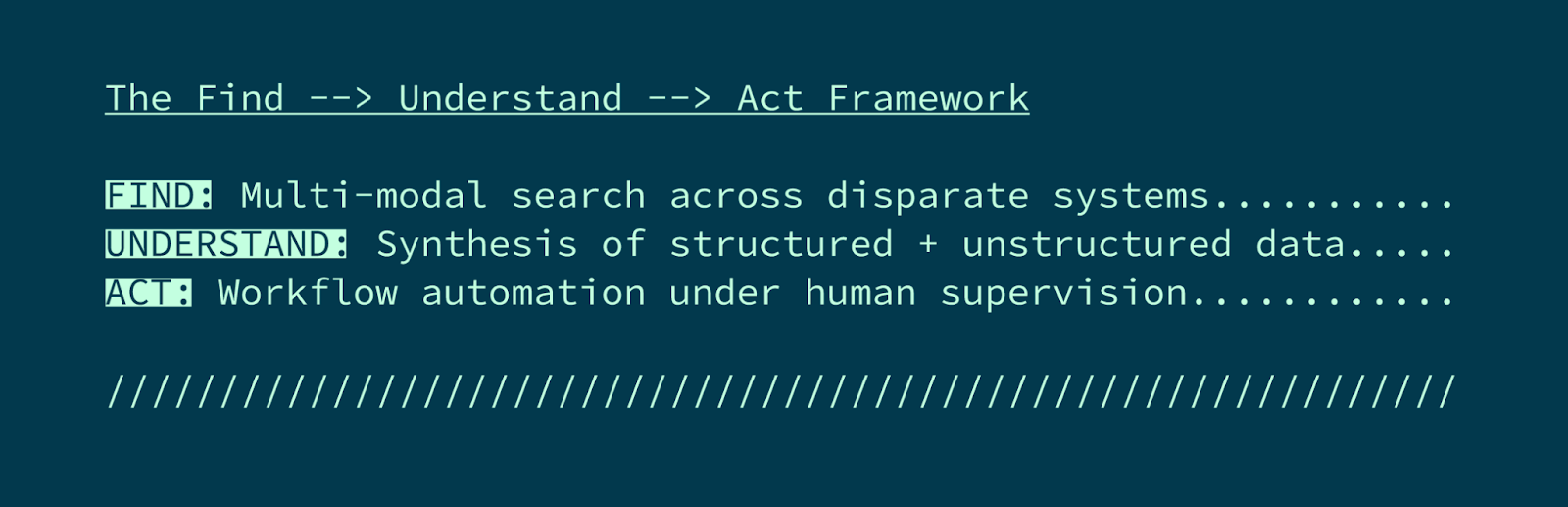
Find: Access information through conversational search across disconnected systems
Understand: Synthesize structured and unstructured data into coherent analysis
Act: Trigger workflows with—and this is critical—appropriate human oversight
Previous technologies could handle one or two of these capabilities. AI agents can do all three while preserving context. That's not incremental improvement. It's a different category of tool. So much so that the technology has suddenly become widespread—even my mum is using Gemini now, though admittedly not the agents yet.
So the fun part starts when we, as an IT consultancy, introduce technology to enterprise clients where product deployment is the least challenging part. We quickly realized that despite having world-class data engineers and data scientists, we needed something else too: change management. Even if it's quite an overused phrase these days, it can't be said enough. AI drives not only technology change, but workflow, process, organizational, and eventually entire company transformations (McKinsey)—from how decisions are prepared to how actions are performed.
Here's what we've learned delivering AI solutions over the past two years: the technology deployment is often the easiest part.
The challenges that derail implementations are organizational. Most companies aren't prepared to answer questions like:
These are governance questions, not technical ones. Change management problems. Human problems.
AI consultancies that focus solely on deployment are missing the point. Companies need partners who help them find answers to these questions. Without solving these, adoption fails—not because the technology doesn't work, but because the organization can't absorb it.
Organizations that succeed treat governance as a first-order design constraint, not an afterthought. They build systems where:
This is what distinguishes production systems from pilot projects. Platforms like Gemini Enterprise enable this by integrating search, reasoning, and action within enterprise security boundaries. Your data never leaves your Virtual Private Cloud. Access controls apply to agents the same way they apply to employees.
The principle is simple: cognitive partners must operate under the same governance as human ones.
Our position at Aliz is straightforward: Don't spend on AI. Spend on AI-enabled workforces.
The organizations succeeding right now aren't the ones with the biggest AI budgets. They're the ones investing in people who understand how to collaborate with these tools, govern their use, and continuously improve the partnership between human judgment and machine capability. Agents are cognitive partners, not completion engines. Supervised autonomy beats generic automation. Every time.
We've been doing this long enough to know: the technology changes every quarter. The principles of good implementation don't.
The AI Agents Handbook includes industry-specific examples showing how leading organizations implement Find → Understand → Act workflows with governance built in. It's designed for leaders who are tired of hype and ready for practical implementation guidance.
Download the handbook to see how companies like yours are making this work in production—not in pilot purgatory.


.png)
.png)
.png)

.png)

